“It’s Cool Inside: Advertising Air Conditioning to Postwar Suburbia.” American Studies 55:4/56:1 (Summer 2017).
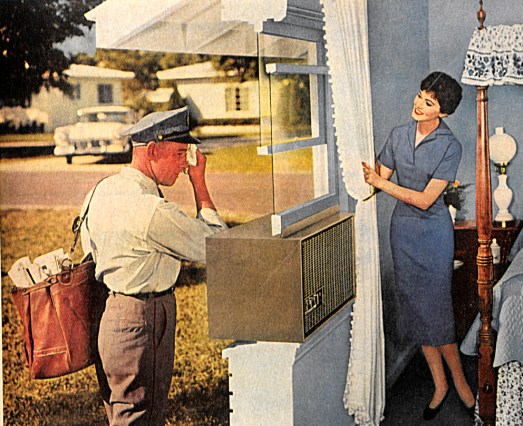
The article explores the visual advertising of air conditioning on popular American magazines in the postwar years (roughly from 1945 to the end of the 1960s), starting from the challenge encountered by art directors. Unlike refrigerators and all other kind of household appliances, the trouble with the new technology was the invisibility of its benefits: how could the cool experience be translated into images? The goal was to dramatize the motionlessness of cool air. In his analysis of the advertising of the era, Marshall McLuhan suggested in The Mechanical Bride that its aim was “to generate heat”, but this might be the case when Madison Avenue actually had to cool down to originate the graphics of refrigeration. An examination of such visual techniques evidences an emphasis on spatial divisions: the outdoors was increasingly associated with labor and the lower classes, whereas cool interiors became the ideal space for the expanding suburban middle class. The history of the visual advertising of air conditioning both mirrors the evolution of the United States into an indoor society and constitutes a historical document of the role that Madison Avenue played in this creation, providing a good example of how society and political life can be shaped through the use of images. Air conditioning lured many Americans inside in search for affluence, upward mobility, technological development, and not just for a shelter from heat and humidity.
 Andrea Vesentini