Indoor America: The Interior Landscape of Postwar Suburbia (University of Virginia Press, 2018)
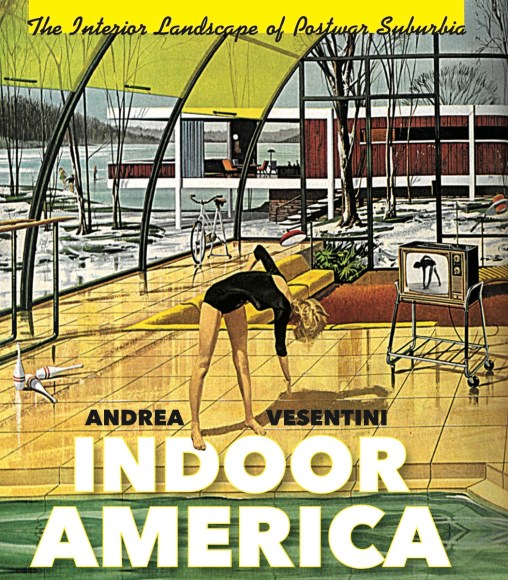
Cars, single-family houses, fallout shelters, air-conditioned malls—these are only some of the many interiors making up the landscape of American suburbia. Indoor America explores the history of suburbanization through the emergence of such spaces in the postwar years, examining their design, use, and representation. By drawing on a wealth of examples ranging from the built environment to popular culture and film, Andrea Vesentini shows how suburban interiors were devised as a continuous cultural landscape of interconnected and self-sufficient escape capsules. The relocation of most everyday practices into indoor spaces has often been overlooked by suburban historiography; Indoor America uncovers this latent history and contrasts it with the dominant reading of suburbanization as pursuit of open space. Americans did not just flee the city by getting out of it—they did so also by getting inside.
Vesentini chronicles this inner-directed flight by describing three separate stages. The encapsulation of the automobile fostered the nuclear segregation of the family from the social fabric and served as a blueprint for all other interiors. Introverted design increasingly turned the focus of the house inward. Finally, through interiorization, the exterior was incorporated into the all-encompassing interior landscape of enclosed malls and projects for indoor cities. In a journey that features tailfin cars and World’s Fair model homes, Richard Neutra’s glass walls and sitcom picture windows, Victor Gruen’s Southdale Center and the Minnesota Experimental City, Indoor America takes the reader into the heart and viscera of America’s urban sprawl.
Reviews:
“Extraordinarily creative and thoughtful, well written and lively. With great originality, Indoor America sets the stage for important conversations about contemporary design, urban planning, and American values. Many scholars have written about suburban houses, landscapes, and shopping malls, but this is the only book I have encountered that examines them as a group within the broad context of cultural politics and social hierarchies in postwar America.“
“…creative and impressively researched… Vesentini brings to bear an impressive and wide-ranging group of sources, including buildings, architectural renderings and critiques, sitcoms, films, magazine articles, advertisements, and both high art and mass media photographs… The ideas presented in the book should be used to inform future research.
“Drawing on a wide range of sources from architectural and urban history, sociology, and media studies, this lively and engaging book argues that the process of post-war suburbanization depended on deliberate strategies of encapsulation, introversion, interiorization... a thoughtful analysis of the cultural significance of suburban living in the post-war popular imagination, and in particular, the meanings of the newly important phenomenon of interiority.”
Joanna Merwood-Salisbury, Journal of the Society of Architectural Historians
“…Vesentini challenges historians to consider the American suburban vernacular and the contexts surrounding its creation on intriguing terms. In doing so, he widens understanding of the genesis of the suburban built environment while also linking his ideas to such well-established contexts as racial and economic exclusion and social conformity.”
James A. Jacobs, The American Historical Review
“A decisive argument Vesentini formulates through this particular reading is the idea that, being conceived in opposition to the city, the suburban dream was also experienced and engineered as an escape route that, thanks to their private cars, the dominant white middle-classes took to avoid the social, economic, and racial tensions that manifested in the city… Running through the entire book, this argument gives Vesentini’s thesis a strong social and political dimension.”
“Andrea Vesentini’s ‘Indoor America’ is a delightful exploration of postwar society…Vesentini does an admirable job of drawing attention to what would be considered by many to be societal norms and the manifestation of those norms in our cities, suburbs, homes and public spaces…The notes and bibliography are a testament to Vesentini’s thoughtful research and presentation of the topic and serve as a treasure trove of sources for further exploration.”
“Vesentini identifies three stages of suburbanization: encapsulation in the automobile, introversion of domestic space, and interiorization of public space (as in enclosed malls or the interconnected indoors of many recent downtown hotels and convention centers). Illustrations from popular postwar magazines and movies help make his point…Chapters on fallout shelters, air conditioning, picture windows, and malls complete this readable, lookable, and thought-provoking book.“
Harold Henderson, Planning
“Vesentini’s concept of interiorization as an aspect of the social and physical landscape of suburbia is one that scholars will undoubtedly engage with as we continue to explore suburbanism and its dominant presence in the American landscape.”
Elaine B. Stiles, Building & Landscapes
 Andrea Vesentini