
Andrea Vesentini, a scholar based in Venice, has studied the imagery and advertising used to sell air conditioning to America in the middle of the last century. The advertisements he has culled from magazines and popular journals depict a dramatic contrast between interior and exterior space, and an emerging inside-outside dichotomy that had strong class overtones.
Philip Kennicott, “Addicted to Cool”, The Washington Post (21 September 2023)

In the middle of the 20th century in the U.S., window coverings were much more contentious, essentially serving as a proxy for the struggle between the country’s cities and its suburbs. At that point, large, single-pane “picture windows” had become a hallmark of suburban homes. Because they offered an unobstructed view of the outdoors and let in lots of sunshine, having them was thought to be good for one’s health, Andrea Vesentini, who wrote the book Indoor America: The Interior Landscape of Postwar Suburbia, told me.
Michael Waters, “Why Rich People Don’t Cover Their Windows”, The Atlantic (22 January 2024)

Eating, cooking, reading, thinking, daydreaming, napping – our lives moved outside during the pandemic, writes David Sax. But as the indoors beckons unrestricted, he’s left wondering whether we might be better off in the open air, and if this is our last chance to shift the balance, for our own good.
David Sax, “The Good Life Begins Outdoors”, The Globe and Mail (10 June 2022)
As a cultural study, Indoor America is a valuable contribution for its elucidation of a recognizable but until now tacit psychosocial pattern of turning inward as American designers, planners, manufacturers, and advertisers shaped real and imagines postwar spaces. Vesentini’s concept of interiorization as an aspect of the social and physical landscape of suburbia is one that scholars will undoubtedly engage with as we continue to explore suburbanism and its dominant presence in the American landscape.
Elaine B. Stiles, Building & Landscapes: Journal of the Vernacular Architecture Form 28:1 (Spring 2021)

Drawing on a wide range of sources from architectural and urban history, sociology, and media studies, this lively and engaging book argues that the process of post-war suburbanization depended on deliberate strategies of encapsulation, introversion, interiorization... a thoughtful analysis of the cultural significance of suburban living in the post-war popular imagination, and in particular, the meanings of the newly important phenomenon of interiority.
Joanna Merwood-Salisbury, Journal of the Society of Architectural Historians 79:4 (December 2020)

Vesentini challenges historians to consider the American suburban vernacular and the contexts surrounding its creation on intriguing terms. In doing so, he widens understanding of the genesis of the suburban built environment while also linking his ideas to such well-established contexts as racial and economic exclusion and social conformity.
James A. Jacobs, The American Historical Review 125:4 (October 2020)

In his creative and impressively researched book, Andrea Vesentini argues that American metro areas turned inward as they sprawled outward… Vesentini brings to bear an impressive and wide-ranging group of sources, including buildings, architectural renderings and critiques, sitcoms, films, magazine articles, advertisements, and both high art and mass media photographs… The ideas presented in the book should be used to inform future research.
Aaron Shkuda, The Journal of American History 106:4 (March 2020)
 In ‘Indoor America’, Andrea Vesentini explores a trajectory that many have hinted at without often describing it systematically: the fact that, throughout the twentieth century, American urbanisation has developed as an indoor phenomenon… A decisive argument Vesentini formulates through this particular reading is the idea that, being conceived in opposition to the city, the suburban dream was also experienced and engineered as an escape route that, thanks to their private cars, the dominant white middle-classes took to avoid the social, economic, and racial tensions that manifested in the city… Running through the entire book, this argument gives Vesentini’s thesis a strong social and political dimension.
Jeremy Lecomte, The Journal of Architecture 24:6 (November 2019)
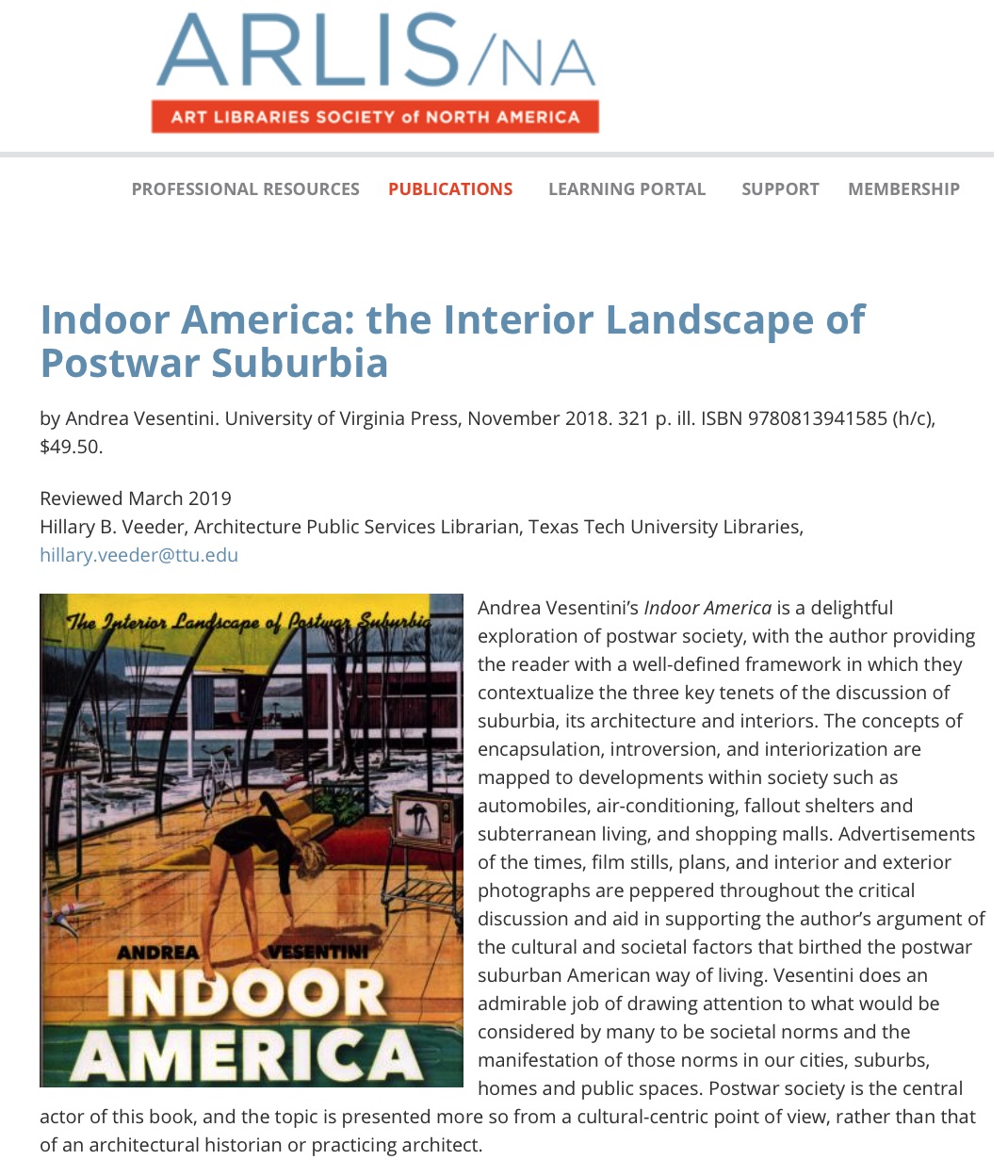
“Andrea Vesentini’s ‘Indoor America’ is a delightful exploration of postwar society…Vesentini does an admirable job of drawing attention to what would be considered by many to be societal norms and the manifestation of those norms in our cities, suburbs, homes and public spaces…The notes and bibliography are a testament to Vesentini’s thoughtful research and presentation of the topic and serve as a treasure trove of sources for further exploration.”
“Vesentini identifies three stages of suburbanization: encapsulation in the automobile, introversion of domestic space, and interiorization of public space (as in enclosed malls or the interconnected indoors of many recent downtown hotels and convention centers). Illustrations from popular postwar magazines and movies help make his point…Chapters on fallout shelters, air conditioning, picture windows, and malls complete this readable, lookable, and thought-provoking book.”
Harold Henderson, Planning: the Magazine of the American Planning Association (February 2019)
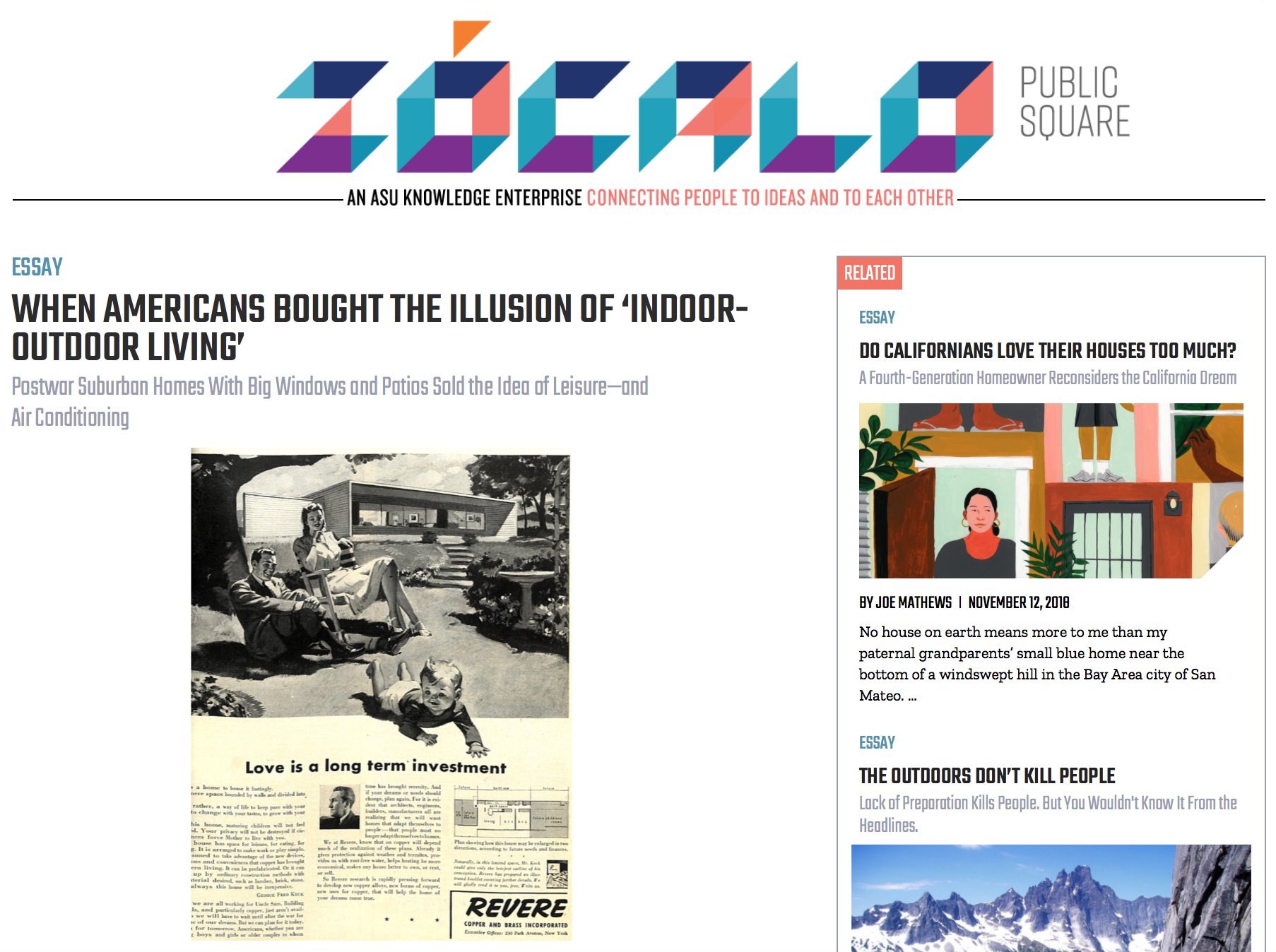
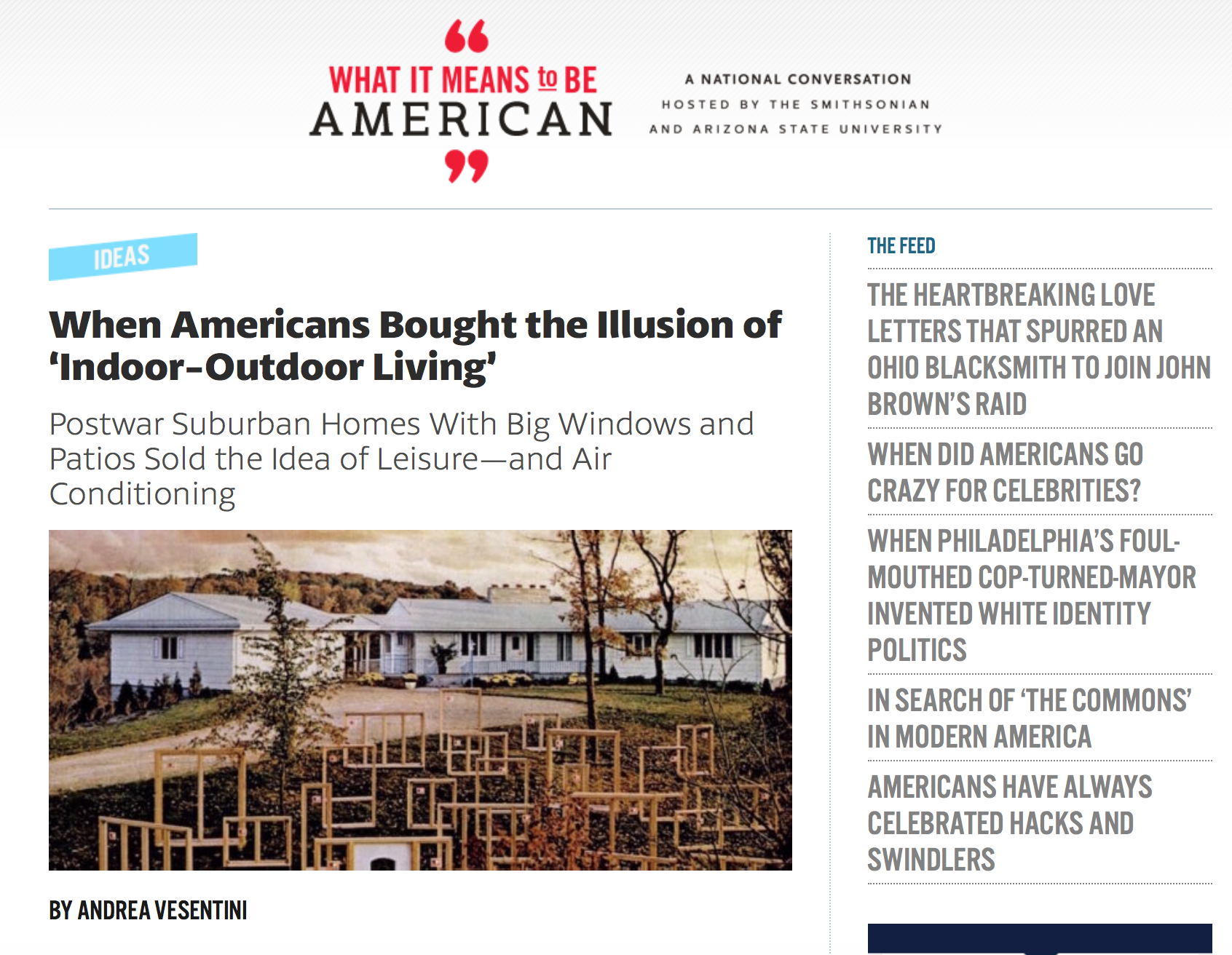
Think of postwar America, and what often comes to mind is a white, heterosexual family, pictured in a domestic suburban environment… This almost-mythical family you are visualizing is drawn directly from a generation of magazine ads, commonplace during the mid-20th century, that portrayed so-called “indoor-outdoor living,” where the refinements of domesticity were combined with the restorative powers of nature… Advertisers dreamed up a seamless interpenetration of indoors and outdoors, homey interiors and sunlit exteriors, living room and back yard—visual evidence that it was possible to have the best of both worlds.
Zócalo Public Square and What It Means To Be American, a National Conversation hosted by the Smithsonian and Arizona State University. “When Americans Bought the Illusion of ‘Indoor-Outdoor Living“ by Andrea Vesentini (17 November 2019)
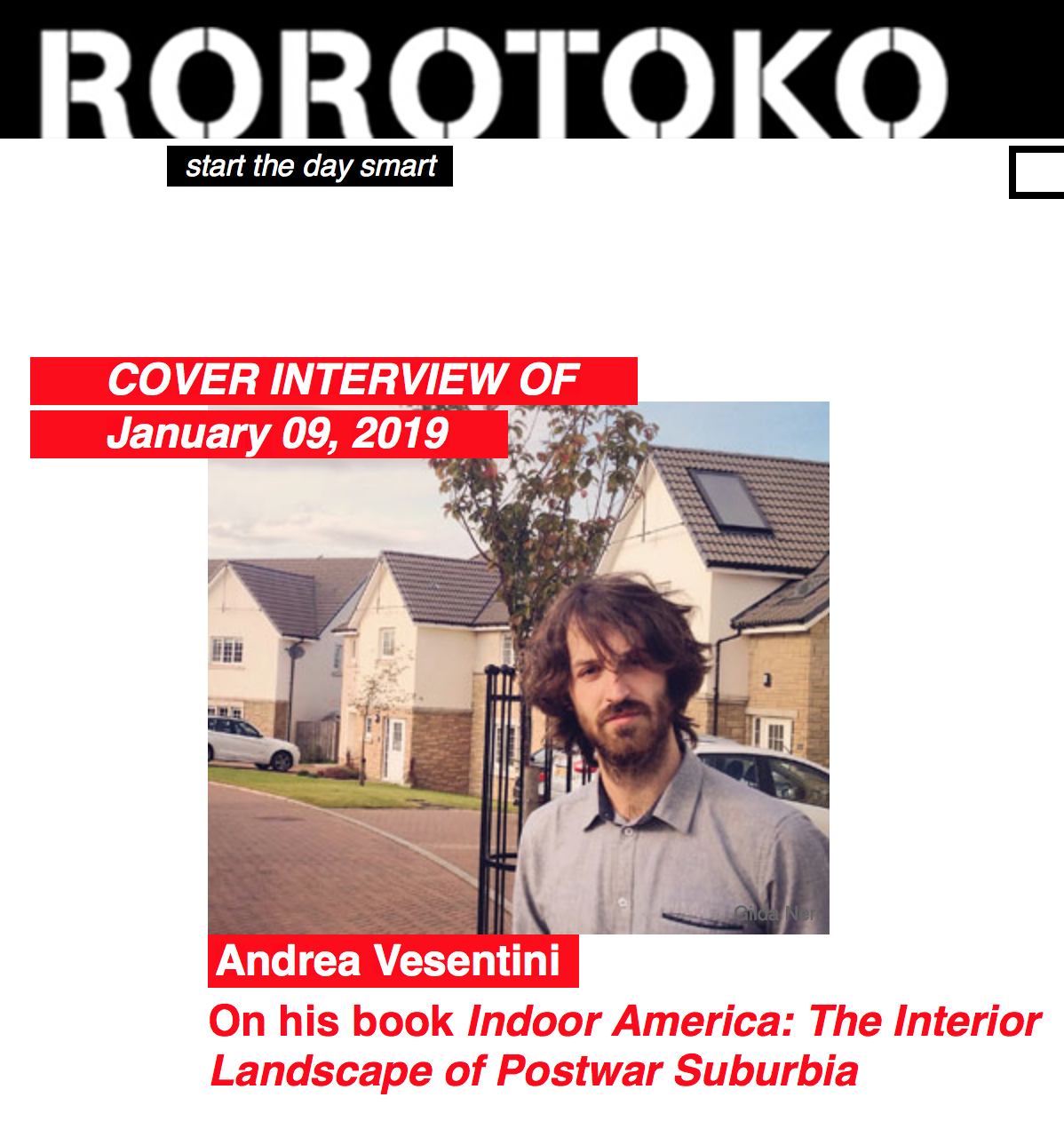
I see this book as a story whose ending is still to be written… However, little progress would be made if places are still designed as defensive oases of privilege and exclusion in the future. Separation and segregation only breed further separation and segregation, ultimately bringing a city’s life to an end. I hope that readers will get a sense of where and how things might have gone differently in the past, and of how much can still be done to improve the state of America’s urban life in the years to come.
Rorotoko. Andrea Vesentini on his book Indoor America: The Interior Landscape of Postwar Suburbia. (9 January 2019)
 Andrea Vesentini